
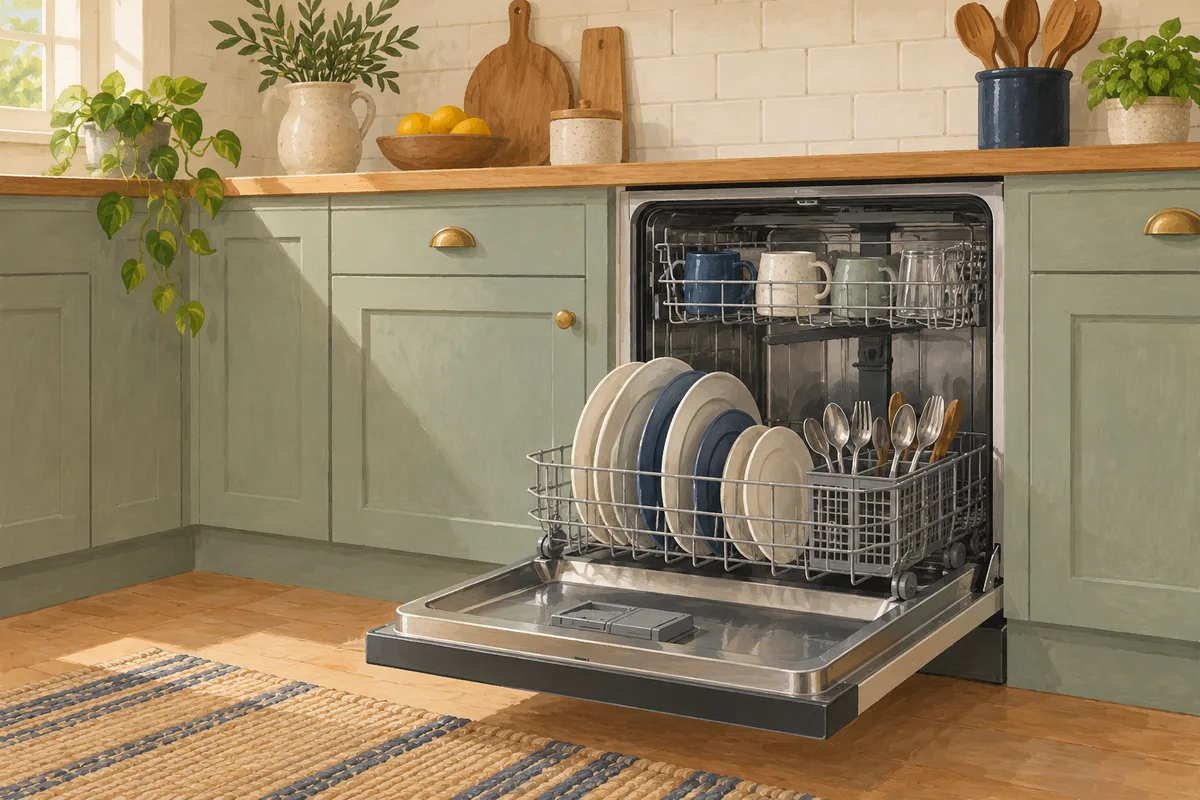
A dishwasher that suddenly starts knocking needs a different response from one making its usual quiet hum. The useful clues are what changed, when the noise occurs, and whether anything else is wrong. A description such as “buzzing” alone cannot identify a failed part.
When to stop before checking the load
Stop using the dishwasher for a new severe grinding sound, a leak, a burning smell, visible damage or an error that its manual says requires service. Do not keep restarting it to obtain a better recording. If there is smoke, fire or an immediate electrical hazard, move away and follow local emergency guidance.
Do not touch plugs or electrical controls while standing in water. Leave electrical isolation and access that you cannot perform safely to a qualified professional. Our safety standards explain why this guide stops before internal repairs.
Match the noise to the cycle, not just a sound label
| Observation | Possible context | Useful next step |
|---|---|---|
| Familiar water swishing during washing | Water spraying inside the tub is an expected operating sound. | Compare with the model's normal-sound guidance if uncertain. |
| Low hum near draining | The drain pump may be operating. | Note whether the sound is new, much louder or accompanied by a drainage problem. |
| Rhythmic knock after loading | An item may be interfering with a spray arm. | Pause safely and check load clearance as described below. |
| Rattle from dishes or lightweight items | Items may be moving or contacting one another. | Check their placement against the loading diagram. |
| New loud grinding or repeated harsh buzzing | Debris or another operating fault is possible. | Stop; use model-specific support rather than guessing which part to replace. |
| Banging that seems to come from household pipes | A plumbing problem may be involved. | Describe it to a plumber or installer; do not modify the supply yourself. |
GE's normal and abnormal noise guide distinguishes operating sounds from load interference and pipe banging. Whirlpool also explains how sounds change between filling, washing, draining and drying. A sound that can be normal on one model is not a reason to dismiss a sudden change on yours.
Check loading when the machine is safely paused and cool
If the concern is a mild load-related rattle or knock, with no warning signs above, follow the manual's pause procedure. Wait for spraying to stop and open the door cautiously as instructed; hot water and steam may be present. Allow hot contents to cool before reaching inside.
- Look for an item hanging below a rack. A utensil or handle may project into the spray arm's path. Reposition it in its intended holder.
- Separate items that are contacting each other. Use the rack's supports and the manual's loading pattern rather than packing dishes tightly together.
- Secure lightweight items. Use the appliance's intended clips or rack positions, if provided. Do not improvise a weight or restraint.
- Check clearance as the manual permits. Ensure the racks are seated correctly. Do not force an arm, remove a fixed part or reach into a moving appliance.
Whirlpool notes that load placement can affect rattling and vibration. Think of the loading diagram as the reference: a photograph of someone else's dishwasher cannot show the clearances in your model.
Only resume normal use if the manual permits it, you have corrected an obvious loading issue, and there are no warning signs. If the noise continues, stop and seek support. Repeated empty cycles are not a general safety test.
A filter check depends on the exact model
Samsung warns that debris around filters can include sharp glass, bone or plastic. It also distinguishes models with removable filters from those without them. Do not infer that a part is removable because a similar machine has a twist-out filter.
For a user-cleanable filter, follow the exact manual's power-off, cooling, removal and refitting instructions. Do not sweep blindly through debris with your fingers. If there may be broken glass, the filter is stuck, access is unclear or the instructions require work beyond routine cleaning, stop and arrange service.
This guide does not cover reaching into a pump, removing an impeller cover or taking off the cabinet. A loud noise that continues beyond permitted checks belongs with the manufacturer or a qualified technician. Do not apply WD-40 or another improvised lubricant.
If ordinary food odor is also present, see what to check when a dishwasher smells. Odor cleaning does not establish the cause of a mechanical noise, and it should not delay service for a warning sign.
Give service support a useful description
Write down a few observations before contacting support. Use what you already know rather than running another cycle to gather evidence:
- Model number and any displayed error code.
- Whether the noise began after a particular load, cleaning, installation or a long idle period.
- The stage when you heard it: filling, washing, draining, drying or moving the door.
- Whether dishes came out clean and whether you noticed a leak or drainage problem.
- The permitted loading or filter checks you completed.
An existing recording can help describe an intermittent sound; Samsung recommends recording noises for service. Do not delay stopping a hazardous appliance to make one. For a newly installed machine, ask the installer to assess the installation rather than pulling it out or adjusting its mounting.
Method: manufacturer guidance synthesized with AI assistance. No sound measurements, teardown or appliance repair tests were performed. The illustration is conceptual and is not a loading diagram for a specific model.