
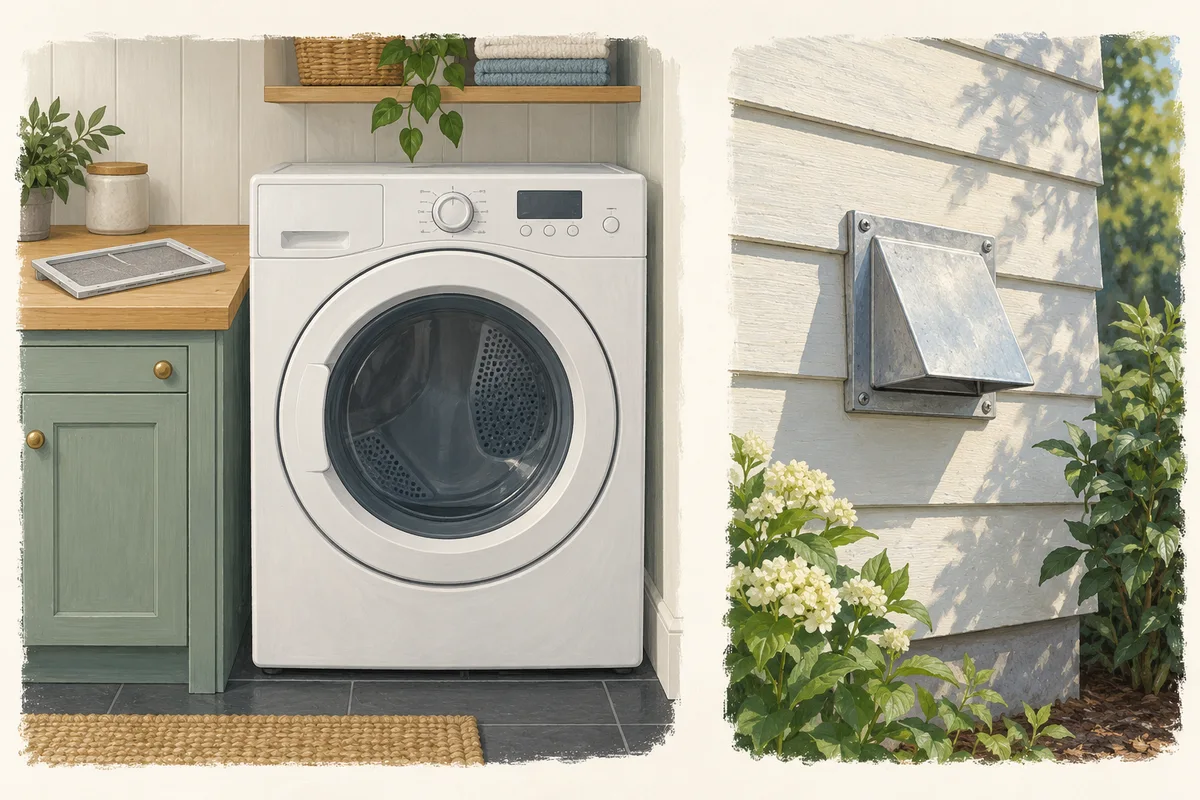
Cleaning the lint screen is routine care. Cleaning the entire exhaust path is a different job: the path can include the connector behind the dryer, a concealed duct, and an outdoor hood. Before buying a brush kit, establish what you can safely access and what your appliance manual permits.
This guide covers ordinary maintenance decisions for a vented household dryer. It is not a gas-connection, electrical-repair, roof-access, or duct-installation tutorial. If you have a ventless heat-pump or condenser dryer, use its own filter and heat-exchanger care instructions instead.
Lint screen, connector, duct, and hood: know the difference
| Part | Purpose | Care boundary |
|---|---|---|
| Lint screen | Catches lint inside the appliance | Remove lint before or after each load; follow the manual for deeper screen cleaning. |
| Connector behind the dryer | Connects the appliance to the household exhaust path | Access and reconnection must follow the model instructions. Do not pull against a cord or gas line. |
| Household exhaust duct | Carries exhaust toward the outdoors | Long, concealed, inaccessible, or uncertain routes call for a qualified service. |
| Exterior hood | Provides the outdoor outlet | Inspect from a safe accessible position; roof or ladder work is outside this guide. |
The CPSC's dryer safety alert explains that lint buildup in the appliance or exhaust duct can restrict airflow and contribute to overheating and fire. It recommends periodic exhaust cleaning and assigns cleaning inside the dryer chassis to a qualified service person.
Recognize signs that need attention
Longer drying times, unusually hot operation, moisture around the dryer, or weak exhaust can be signs of a ventilation problem. GE's venting guidance also points to kinked or collapsed ducting. These signs do not prove that lint is the only cause.
- Smoke, fire, or a smoke alarm: leave the building and call 911 from outside. Do not investigate the vent or begin cleaning.
- Burning odor, overheating, repeated shutdowns, or damaged wiring: stop using the dryer and arrange an assessment. Do not run another heated cycle to see whether it improves.
- Slower drying without emergency signs: check the lint screen and the manufacturer's troubleshooting guidance; arrange exhaust inspection if the problem persists.
The U.S. Fire Administration advises getting outside and staying at the meeting place in a fire. The Cambridge Fire Department specifically advises calling 911 for dryer fire or smoke.
Decide whether the job is suitable for owner maintenance
Find the dryer model and read its use-and-care and installation instructions. Identify whether it uses gas or electricity, where the exhaust exits, and whether the full route is known. If you cannot answer those questions, do not start by moving the machine.
This includes gas-line work, hardwired equipment, stacked or heavy appliances you cannot move safely, roof outlets, concealed routes, damaged ducting, nests, and a cleaning tool that becomes stuck. Do not disconnect or cap a gas line using this article.
Whirlpool's cleaning guide calls for unplugging before maintenance and two or more people when moving the appliance. Its broader instructions cover situations beyond this page's owner-maintenance scope. Having a brush kit does not establish that your installation is suitable for DIY cleaning.
What accessible routine care involves
- Stop and let the dryer cool. For hands-on maintenance beyond normal lint-screen care, disconnect electrical power as the manual directs. If safe isolation requires electrical or gas work, have a qualified professional handle it.
- Clean the lint screen. Remove it as instructed, collect lint, and reinstall it correctly. Follow the model's procedure for residue on the mesh; do not operate without the screen. Keep the accessible area around the appliance free of loose lint and clutter.
- Inspect the accessible outdoor outlet. With the dryer off, look for visible lint or an obstruction from a safe ground-level position. Follow the hood and appliance instructions for removing accessible debris. Do not reach blindly into a duct, disturb a nest, or force a flap.
- Limit duct cleaning to documented access. If the manufacturer expressly provides an owner procedure and the entire required access is safe, follow it. GE's basic procedure describes disconnecting electrical power, detaching the duct, vacuuming it, and reconnecting it. That is not a guarantee that a vacuum reaches your whole exhaust route.
- Stop at uncertainty. If you cannot confirm that the route is clear and the connections are properly restored, leave the dryer out of use and arrange service. Cleaning only the visible opening is not confirmation of a clear concealed duct.
See GE's exhaust-cleaning instructions for the source of that limited procedure. Use your own model's directions for fasteners, access, and reconnection. Do not improvise with a drill-driven brush, blower, or long extension inside an unknown route.
What to confirm before returning it to use
All connections and covers must be restored according to the manufacturer before operation. Do not run the dryer with its exhaust disconnected indoors. Make sure repositioning has not crushed the connector. If a connection is damaged or will not secure correctly, it needs repair rather than a workaround.
When the appliance has been correctly reassembled and there are no warning signs, follow its specified operational check. The outdoor flap should be able to open and exhaust should escape; an outlet that remains obstructed needs attention. A visible flow check is useful, but it is not a measurement proving that every installation requirement is met.
The Department of Energy-funded Building America guide illustrates outlet and duct checks. It also shows why avoiding a crushed path matters. Installation changes, duct sizing, and route corrections remain outside this guide.
How often should the vent be cleaned?
Use the appliance instructions and actual conditions, not a universal promise that a cleanout lasts a fixed time. GE recommends inspecting and cleaning exhaust ducting at least annually. Whirlpool's vent-check guidance describes one to two years, or as needed when performance declines, depending on use and the loads dried.
The practical distinction is straightforward: lint-screen care belongs with each load; exhaust inspection and cleaning are a separate recurring task. Record the service date, who cleaned it, what sections were covered, and any defects found. Do not wait for the calendar if performance changes or warning signs appear.
What to ask a cleaning service
Describe the dryer type, outlet location, access constraints, symptoms, and any known route information before booking. Ask whether the service includes the connector, the full household duct, the outdoor hood, and a post-service check. Ask them to identify damage or restrictions that cleaning cannot correct.
If opening the appliance cabinet is needed, confirm that the person is qualified for that work. Request a record of what was actually cleaned instead of assuming a photograph of removed lint proves the entire system is clear.
A dryer problem and a washer odor are different investigations. If the smell comes from the empty washing machine, see our front-load washer odor guide.
Method: U.S. safety-agency and manufacturer guidance compared with AI assistance. No appliance inspection, airflow measurement, or independent technical review was performed. See our safety standards.