
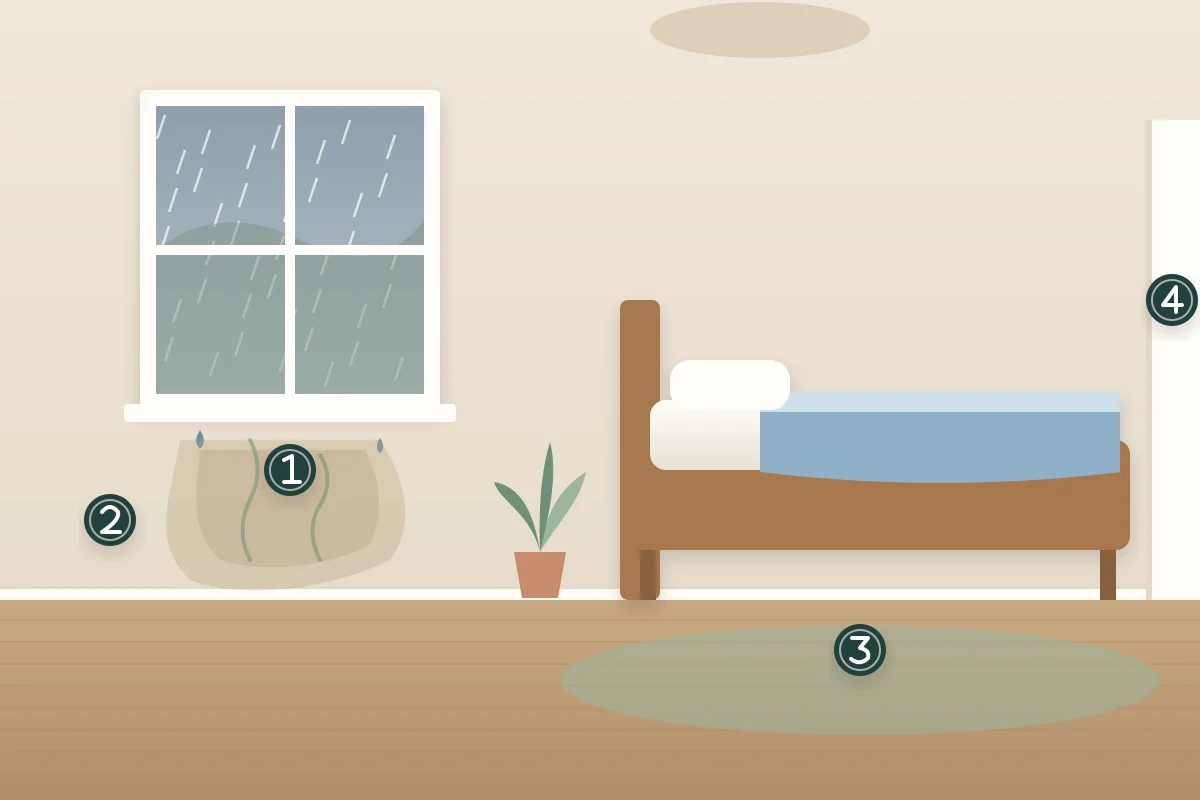
Musty smell in bedroom after rain? It usually means water is getting into, or staying in, materials near the room: an exterior wall, a window frame, the roof above, or a floor over a damp crawl space. The smell does not identify the source. Record when it starts and where it is strongest, and get the area inspected if it returns after every storm.
This guide gives you a simple four-zone record to fill in before, during and after rain. It turns a vague smell into notes a roofer, window installer or moisture inspector can act on.
Musty smell in bedroom after rain: trace the pattern
Pick four fixed zones and check them the same way each time. Stand in each zone for about 30 seconds; you do not need to sniff surfaces closely.
- Window zone: the sill, frame corners and the wall below the window.
- Exterior wall zone: the base of the wall, the corners and behind furniture.
- Floor zone: carpet edges, under the bed and any floor vent.
- Closet zone: inside the closet with the door closed for at least an hour.
Check each zone at three moments: a dry day before rain, during or within 2 hours of rain, and 24–48 hours later. Note the smell (none, faint, strong), anything visible, the humidity reading if you have a meter, and whether the heating or air conditioning was running.
Four-zone record: what each result suggests
| Zone | Before rain | During or after rain | Possible source | Who to call |
|---|---|---|---|---|
| Window | No smell | Smell, damp sill or stained frame | Leaking window seal or flashing | Window installer or contractor |
| Exterior wall | Faint smell | Stronger smell, darker patches low on the wall | Water entering the wall, gutters overflowing | Contractor or moisture inspector |
| Upper wall or ceiling | No smell | Smell, ceiling stain | Roof or attic leak | Roofer |
| Floor | Faint smell | Stronger smell from carpet or vents | Damp crawl space or foundation | Foundation or crawl-space specialist |
| Closet | Faint smell | Stronger with the door closed | Cold exterior wall, poor airflow | Start with airflow and humidity checks |
| Whole room equally | Some smell | Worse on humid days | High indoor humidity | Ventilation or HVAC technician |
Take a photo of any stain the first time you see it. Comparing photos after the next storm shows whether it is spreading.
Why does my bedroom suddenly smell musty?
A new musty smell usually means something has recently become damp. After rain, the usual suspects are a leaking roof or window, gutters overflowing against the wall, or ground water reaching the foundation.
The EPA notes that you may suspect hidden mold if a building smells moldy but you cannot see the source. It lists places such as behind drywall and wallpaper, under carpet and pads, and inside walls.
Outside, check that downspouts discharge away from the house. The U.S. Department of Energy’s building guidance calls for roof water to reach a sloped grade more than 5 feet from the foundation.
Is it safe to sleep in a room that smells musty?
The smell alone cannot tell you. It signals moisture and possibly mold growth, so treat it as a problem to solve, not something to air out and forget.
- Sleep elsewhere if you see visible mold, wet materials or water damage.
- Get medical advice if anyone has asthma, allergies or breathing problems that seem to worsen in the room.
- Avoid disturbing damp drywall or carpet until the source is found.
How do you deal with a musty smell after rain?
Find and stop the water first, then dry the room, then remove the smell. Reversing that order hides the problem.
- Dry any wet materials within 24–48 hours; the EPA says mold usually will not grow if materials are dried in that time.
- Keep indoor humidity below 60%, ideally 30–50%, with ventilation, air conditioning or a dehumidifier.
- Clear gutters and check that downspouts drain away from the house.
- Book the right specialist using your four-zone notes.
Air fresheners and scented candles can make the odor harder to track. Do not climb onto the roof or open walls yourself. The EPA’s cleanup criteria say neither visible mold nor moldy odors should remain once the job is done.
Musty smells that appear after showers rather than storms have a different source. See our guide to a bathroom that smells musty after a shower.
Can a room smell musty without mold?
Yes. Damp carpet, wet wood, a closed-up closet or a dirty air conditioner can all smell musty before any growth is visible. That is why recording humidity and timing is more useful than guessing from the smell.
If the odor is strongest in a closet on an outside wall, compare the closet with the room as described in our guide to mold in a closet on an outside wall.
Quick questions
How many storms should I record?
Two or three is usually enough to show a repeat pattern. One event can be a coincidence.
If a dehumidifier removes the smell, is the problem solved?
Not necessarily. Lower humidity can reduce the smell while water still enters during rain. Keep checking the zones after the next storm.