
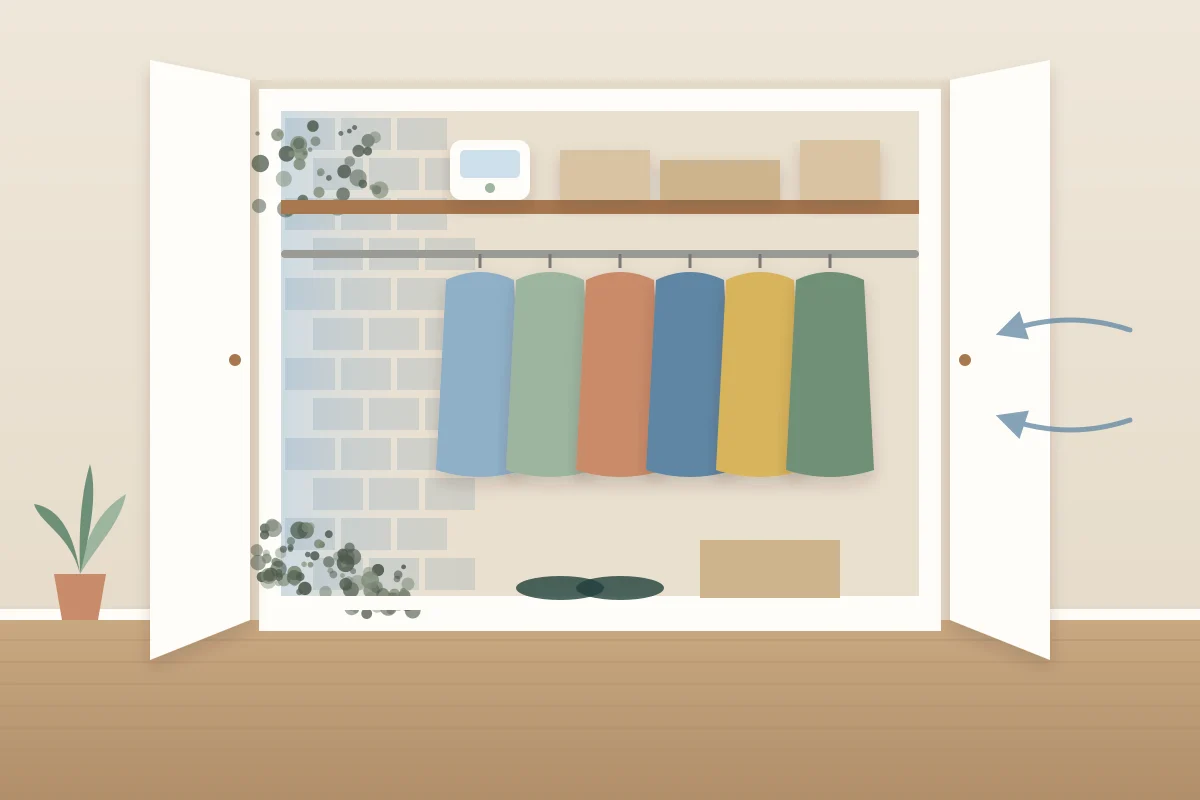
Mold in a closet on an outside wall usually grows because that wall is colder than the rest of the room, so the air right beside it stays more humid, and clothes or boxes packed against it block the airflow that would dry it. A leak is the other possibility. Clear the wall, compare the closet with the bedroom, and fix the moisture source before cleaning or repainting.
The steps below show how to tell a condensation problem from a leak without opening the wall, and when a patch is too large to handle yourself.
Why mold grows in a closet on an outside wall
North Dakota State University Extension explains that a closet cooler than the rest of the house can reach a relative humidity that supports mold, even when the house air is dry, and that this typically happens near the outside wall.
Three conditions usually combine:
- A cold surface: in winter the exterior wall is the coldest surface in the closet.
- No airflow: a closed door and a full rail keep warm room air away from that wall.
- A moisture supply: damp clothes, high indoor humidity or water coming through the wall.
Remove any one of the three and growth usually slows. Removing the moisture source is what keeps the mold from coming back.
What to check first, without opening the wall
- Empty the section of closet next to the affected wall. Bag visibly moldy items separately from clean ones.
- Photograph the patch with a ruler or tape measure beside it, so you can see later whether it is growing.
- Note where it sits: corners, the baseboard, behind a shelf, or high near the ceiling.
- Compare the closet with the bedroom. Read a humidity meter in the middle of the bedroom, then inside the closet with the door closed for an hour.
- Look for water signs: stains that darken after rain, bubbling paint, a soft baseboard or a damp carpet edge.
A closet reading well above the bedroom, with spots spread along a cold corner, points to condensation. Staining that grows after storms, or is wetter at one spot, points to water getting in from outside.
Closet vs. bedroom: what the comparison suggests
| Sign in the closet | Compared with the bedroom | Possible cause | What to do |
|---|---|---|---|
| Spots in cold corners, more in winter | Closet more humid, room within 30–50% | Condensation on a cold wall | Clear the wall, open the door, improve airflow |
| Spots throughout the room too | Both rooms above 60% | High indoor humidity | Lower whole-room humidity first |
| Stain darkens after rain | Change linked to weather, not heating | Water entering from outside | Have the exterior wall, roof or gutters inspected |
| Soft baseboard, damp carpet edge | Wet only at floor level | Leak or water wicking up | Arrange a moisture inspection |
| Patch larger than about 10 sq ft | Any reading | Extensive growth | Use professional remediation |
If the window in the same room also streams with water on cold mornings, the bedroom is holding too much moisture. Our guide to condensation on the inside of windows covers indoor humidity and ventilation checks that help the closet too.
Why am I getting mold on external walls?
Exterior walls are colder than interior walls, so indoor moisture condenses on them first. Corners, the space behind furniture and the inside of closets are the coldest and least ventilated spots, which is why mold appears there before anywhere else.
The EPA recommends keeping indoor humidity below 60%, ideally 30–50%. Water coming through the wall is a separate problem, and lowering humidity will not fix it.
What happens if you have mold in your closet?
It can spread to stored items and keep returning until the moisture is controlled. Clothes, shoes, cardboard boxes and bags absorb moisture and may develop spots or a musty smell.
- Wash or dry-clean affected clothing according to its care label, and dry it completely before putting it back.
- Discard moldy cardboard; NDSU notes that boxed items stay wet if they become damp.
- Replace porous items that cannot be cleaned and dried.
If you plan to run a dehumidifier in the closet, check first whether a dehumidifier can go in a closet: clearance and airflow requirements decide whether it will work there.
How do you get rid of mold in a closet on an outside wall?
Fix the moisture, then clean the surface, then change how the closet is used. The EPA says areas smaller than about 10 square feet can usually be handled by the homeowner.
- Wear gloves, goggles and an N-95 respirator, as the EPA recommends for cleanup.
- Scrub hard surfaces with detergent and water, then dry them completely.
- Do not paint or caulk over mold; the EPA warns that paint applied over it will likely peel.
- Keep stored items a few inches away from the outside wall.
- Leave the closet door open during very cold weather, as NDSU advises.
Bleach combined with ammonia or other cleaners can release toxic gases. Do not cut into the wall to look for hidden mold; disturbing it can spread spores. Get a professional inspection if you suspect water inside the wall.
Quick questions
What if the closet smells musty but I see no mold?
Track when the smell appears. If it follows rain, use our guide to a musty smell in the bedroom after rain to record the pattern.
Does the color of the mold matter?
No. Color does not tell you how harmful mold is; any growth needs the same response: stop the moisture and clean it up.
How soon will I know if the fix worked?
Recheck the photographed spot every week through the cold season. No new growth and closet readings close to the bedroom’s are good signs.