
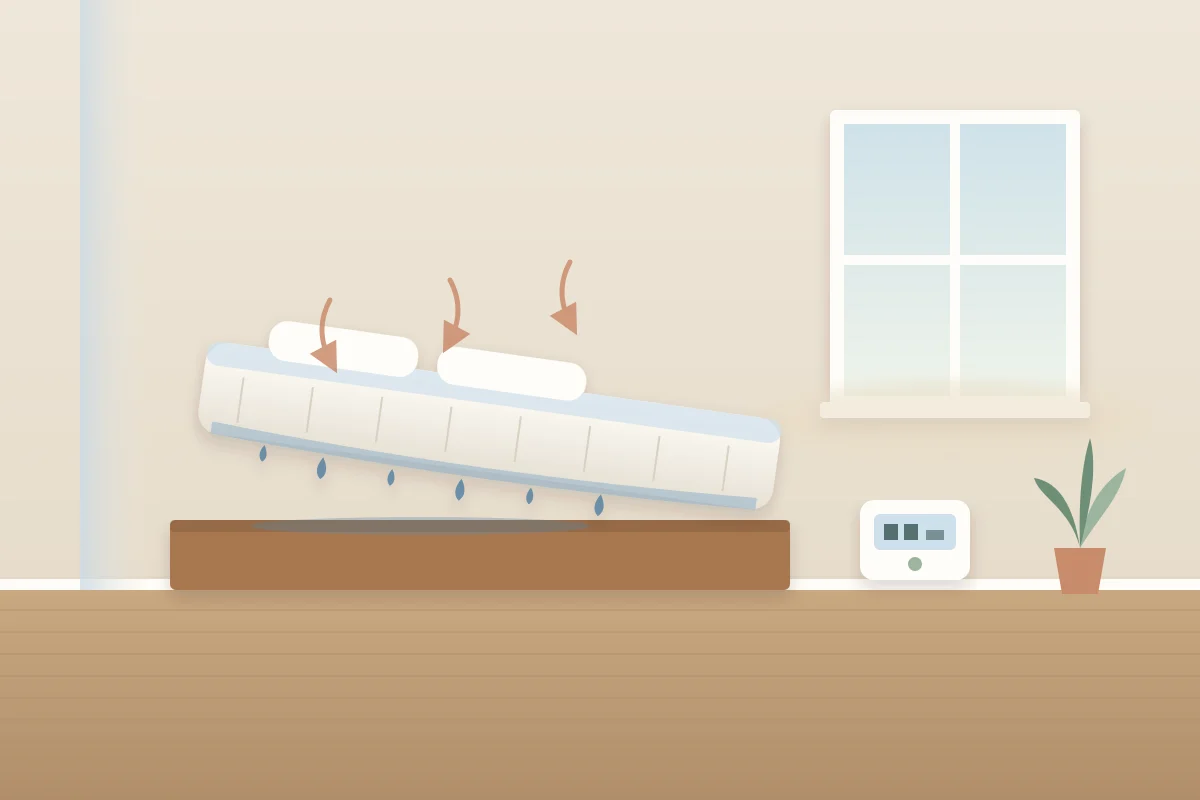
Why is my mattress wet underneath? Usually because body heat and moisture pass down through the mattress and condense on a cooler surface below it, such as a floor, solid platform or plywood base. A spill, a leak or very high room humidity are the other likely causes. Lift the mattress, find out which surface is wet, and dry it within 24–48 hours.
The checks below separate the mattress, the base and the floor, because each one points to a different fix. The table then matches what you see to the most likely next step.
Why is my mattress wet underneath? Find the wet surface first
Do this in daylight, with the bedding removed. Ask someone to help you lift a queen or king mattress: it is heavy, and you want to see both the underside and the base without dragging fabric across a wet floor.
- Lift the mattress on one side and feel the bottom cover. Note whether the dampness covers a large area under the sleeping zone or forms one small patch.
- Check the base: slats, a solid platform, a box spring or a plywood board. Is the base itself wet, stained or darker?
- Check the floor or carpet under the bed, especially near an exterior wall, a window or a radiator pipe.
- Smell and look for a musty odor, dark spots or fuzzy growth. Do not sniff deeply; one ordinary breath is enough.
- Write down the room conditions: season, heating, and the humidity level if you have a meter.
A large, even damp zone under the sleeping area usually means trapped moisture and condensation. A small patch with a clear edge suggests a spill or a drip from above. A wet floor reaching past the bed points to a leak or water entering the room.
What the wet spot is telling you
| Wet surface | Typical pattern | Likely cause | Next step |
|---|---|---|---|
| Mattress underside only | Broad damp area under the sleepers | Body moisture condensing on a cool, airtight base | Dry the mattress, then add airflow under it |
| Mattress and solid base | Base darker or wet in the same area | Solid platform, plywood or floor with no ventilation | Switch to a slatted or ventilated base the maker approves |
| Floor or carpet under the bed | Wet patch extends beyond the mattress | Leak, water entering from a wall, or a cold floor | Trace the water source before drying anything else |
| Small patch with a sharp edge | One spot, often with a tide line | Spill or drip from above | Blot and air-dry following the care label |
| Any surface with dark spots or fuzz | Musty smell, visible growth | Mold has started | Stop and assess before sleeping on it again |
Why condensation forms under a mattress
A sleeping person releases heat and water vapor all night. A mattress lets some of that moisture move downward. When it reaches a surface colder than the air inside the mattress, it condenses, just like water droplets on a cold window.
The risk goes up with a mattress directly on the floor, a solid platform with no gaps, a cold concrete or tile floor, and a bedroom with high humidity. Bear’s help center notes that a mattress on the floor can trap moisture by reducing airflow underneath, and that carpet can hold extra heat and moisture.
If your windows also fog up on cold mornings, the room itself is holding a lot of moisture. Our guide to condensation on the inside of windows explains how to check indoor humidity and ventilation, and it applies to the bedroom as a whole.
How do I stop moisture under my mattress?
Give the underside a path for air and keep room humidity in range. The EPA recommends keeping indoor humidity below 60%, ideally between 30% and 50%. A basic humidity meter costs about $10–$50.
- Raise the mattress off the floor on a frame or foundation your mattress maker approves. Check its warranty for base and slat-spacing rules before you buy.
- Avoid sealing the base: plastic sheeting, rugs or storage boxes packed under a bed all block airflow.
- Pull the bed a few inches away from a cold exterior wall so air can circulate.
- Air the bed each morning: fold back the covers for 20–30 minutes before making it.
- Ventilate or dehumidify the bedroom when humidity stays above 60%.
Is it safe to sleep on a damp mattress?
Not until it is completely dry and shows no signs of mold. Moisture held inside foam or fibers keeps the material damp, and the EPA notes that mold usually does not grow when wet materials are dried within 24–48 hours.
Sleep somewhere else for the night if the mattress feels damp inside, smells musty or has dark spots. If anyone in the home has asthma, allergies or a weakened immune system, get advice from a medical professional instead of relying on smell alone.
Fragrance sprays, heavy powders or a new mattress protector can hide dampness without removing it. Do not soak the mattress with cleaning solutions or bleach, and follow the care label for any product you use.
Is my mattress ruined if it gets wet?
Not always. A small spill dried quickly is usually recoverable. Large-scale soaking, flood water, or mold that spreads inside the mattress usually is not.
Tempur-Pedic’s spill-care steps show the general approach for foam:
- Blot excess liquid with a clean towel. Do not rub, because rubbing spreads moisture deeper.
- Wash a removable cover in cold water if its label allows, and dry it flat or on low heat.
- Spot-clean a fixed cover without saturating it.
- Air-dry completely, with a fan blowing across the damp area.
Tempur-Pedic warns that its foam should never be soaked, so check your own maker’s instructions. Replace the mattress if it was soaked by flood water or sewage, or if mold growth is visible inside. Porous materials that become moldy may need to be thrown away.
Quick questions
Can a box spring cause dampness?
Yes, if it sits on a cold floor or is already damp. Check its underside too; a wet foundation will keep re-wetting a dry mattress.
Is the dampness worse after rain?
If the bed sits against an exterior wall and the problem follows storms, read our guide to a musty smell in the bedroom after rain to trace water entering the room.
How often should I check under the mattress?
Once a week for a month after you change the base, then monthly during cold or humid seasons. Note what you find so you can see whether the fix worked.