
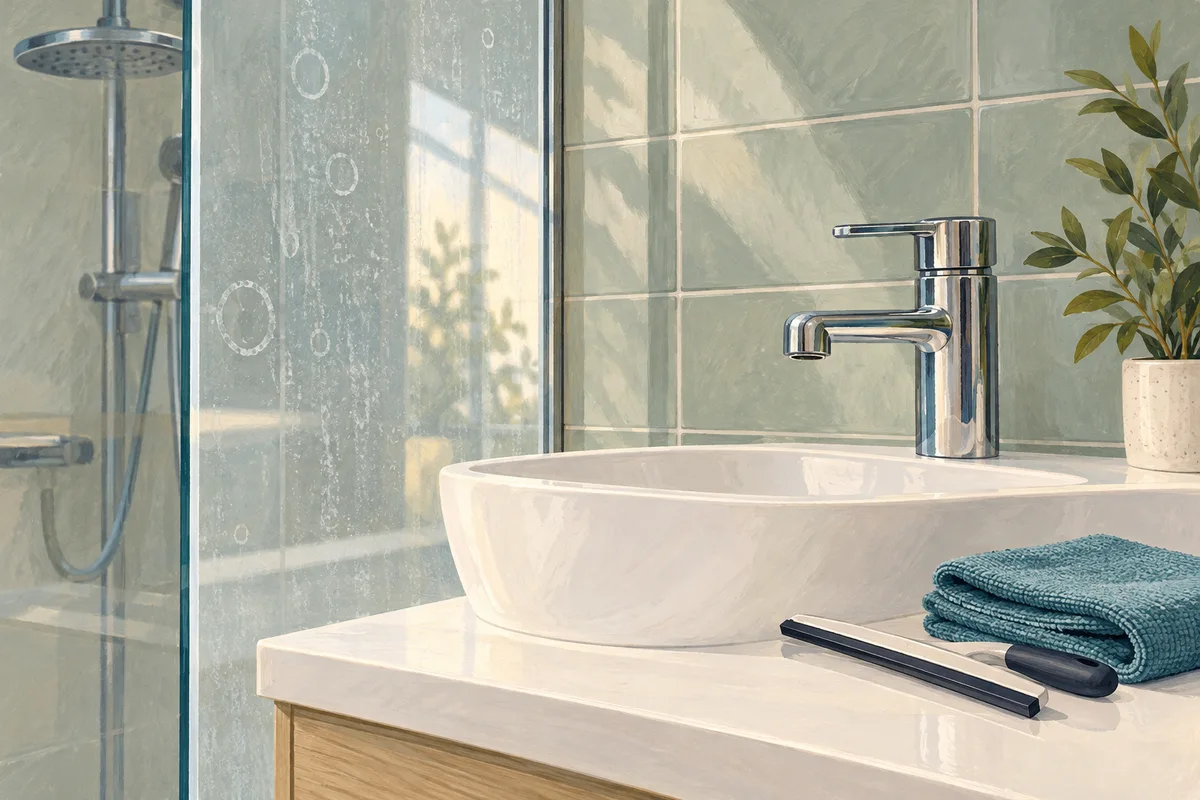
The white rings on a shower door and the pale crust around a faucet may look like the same problem. The surfaces underneath them can require very different care. Before reaching for vinegar or a limescale remover, identify what the cleaner will touch—including the frame, trim, grout, and counter nearby.
Is it a deposit, a smear, or surface damage?
Hard water contains dissolved minerals, especially calcium and magnesium. It can leave deposits and contribute to soap scum, as the USGS explanation of water hardness describes. But a white mark alone does not confirm its cause.
| Observation | Next check |
|---|---|
| Pale rings where droplets regularly dry | Check for mineral residue and identify the surface before choosing a cleaner. |
| A smear appears after wiping | Check cleaner residue and the cloth before treating it as scale. |
| Loose fibers catch the light | Use our guide to lint left on glass; descaling will not fix a shedding cloth. |
| A dull, scratched, peeling, or discolored patch remains | Stop escalating the cleaning method. Ask the surface manufacturer whether it may be damage. |
Photograph the dry surface before trying a permitted method. Compare it after rinsing and drying under similar light. This gives you a useful record without assuming every mark is removable.
Choose by surface, not by the stain alone
| Surface | Start here | Do not assume |
|---|---|---|
| Shower glass | Check the door maker's care guide, including any protective coating. Use its approved cloth and cleaner. | A method allowed on the glass is safe for the metal frame. |
| Faucet finish | Find the brand and finish name. Start with the specified gentle cleaning method. | All silver-colored surfaces are the same metal or finish. |
| Ceramic or porcelain tile | Check the tile, grout, and sealant instructions together; choose a product compatible with all exposed materials. | A tile-safe descaler is also safe for grout or nearby trim. |
| Natural stone | Use the stone supplier's guidance and a compatible non-acidic cleaner. | Vinegar is safe because it is a household ingredient. |
| Unknown material or coating | Identify it or ask the manufacturer before a stronger treatment. | A hidden test makes an explicitly prohibited product safe. |
These distinctions change the answer. Sterling's shower-door instructions call for gentle care and prohibit acids on metal surfaces. Moen organizes its care instructions by finish, with additional restrictions for finishes such as Spot Resist. Permission from one guide should not be transferred to a different product.
A controlled cleaning sequence
- Read both sets of instructions. Confirm that the surface maker allows the cleaner and that the cleaner label lists the material. Check dilution, contact time, rinsing, ventilation, and protective equipment. Resolve conflicts before proceeding.
- Start with the maker's gentle routine. Use a clean soft cloth and the permitted water or mild-detergent method. Rinse and dry. This can remove ordinary residue before you decide whether a mineral-specific treatment is needed.
- Keep the treatment contained. Avoid contact with neighboring stone, grout, seals, and metal that the product does not permit. If you cannot prevent runoff onto an incompatible surface, choose another method.
- Test only an allowed product. Follow any manufacturer instructions for an inconspicuous-area test. Use the specified dose and time; do not leave a soaked cloth overnight unless the exact product instructions require it.
- Rinse, dry, and reassess. Remove the cleaner as directed. Look at the dry result before deciding on another application. Stop if the finish changes, the surface scratches, or the treatment produces no useful improvement.
Never mix bleach with vinegar or other cleaners. Follow the CDC's bleach safety guidance and the product label. A stronger mixture is not a substitute for material compatibility.
When is vinegar actually an option?
Some manufacturers expressly permit it. Delta describes a 50/50 white-vinegar and water solution for hard-water stains on its faucets, followed by thorough rinsing. Its same guidance excludes harsh abrasives and several aggressive cleaners.
Kohler also describes diluted white vinegar for mineral buildup on applicable faucets. That is a product-care example, not a universal recipe for the whole bathroom. Follow your own faucet's instructions, including any restrictions on contact time.
For stone, the answer changes. The Natural Stone Institute warns that acids can dull or etch calcareous stone and does not recommend acidic cleaners for siliceous stone either. Use the supplier's stone-safe method. Do not spray an entire mixed-material shower with a glass-cleaning recipe.
If the marks remain after compatible cleaning
A persistent mark is a reason to reconsider the diagnosis, not automatically to scrub harder. Check whether the product was appropriate, used as labeled, and fully rinsed. Then contact the manufacturer with the material or model, a dry-surface photo, and the products already used.
Do not progress to razor blades, abrasive powders, steel wool, stronger acids, or improvised polishing on an unidentified surface. Peeling, pitting, scratching, or loss of gloss needs a material-specific assessment. This guide does not restore etched stone, damaged coatings, or scratched glass.
Faucet disassembly is a separate job. Cleaning an external deposit does not require forcing a stuck handle or removing plumbing parts. Ask the manufacturer for the correct service route if buildup affects operation.
Reduce the next round of spots
Remove leftover water with a compatible squeegee or soft cloth after use, then let the surface dry. Sterling recommends this for its shower doors; Delta recommends blotting water from its faucet finishes. Keep the cloth clean so that grit and old cleaner are not carried back onto the surface.
If deposits return quickly, record where they appear and check your local water information. USGS cautions that regional hardness maps are not precise enough to diagnose an individual home's water. Cleaning the surface does not change the water supply, and this guide does not recommend or size a water-treatment system.
Method: manufacturer and materials-association guidance compared with AI assistance. No independent stain-removal tests were performed. See our editorial policy.
For a separate problem with an appliance, see what to check when a dishwasher smells. Surface stain treatments are not instructions for cleaning its internal parts.