
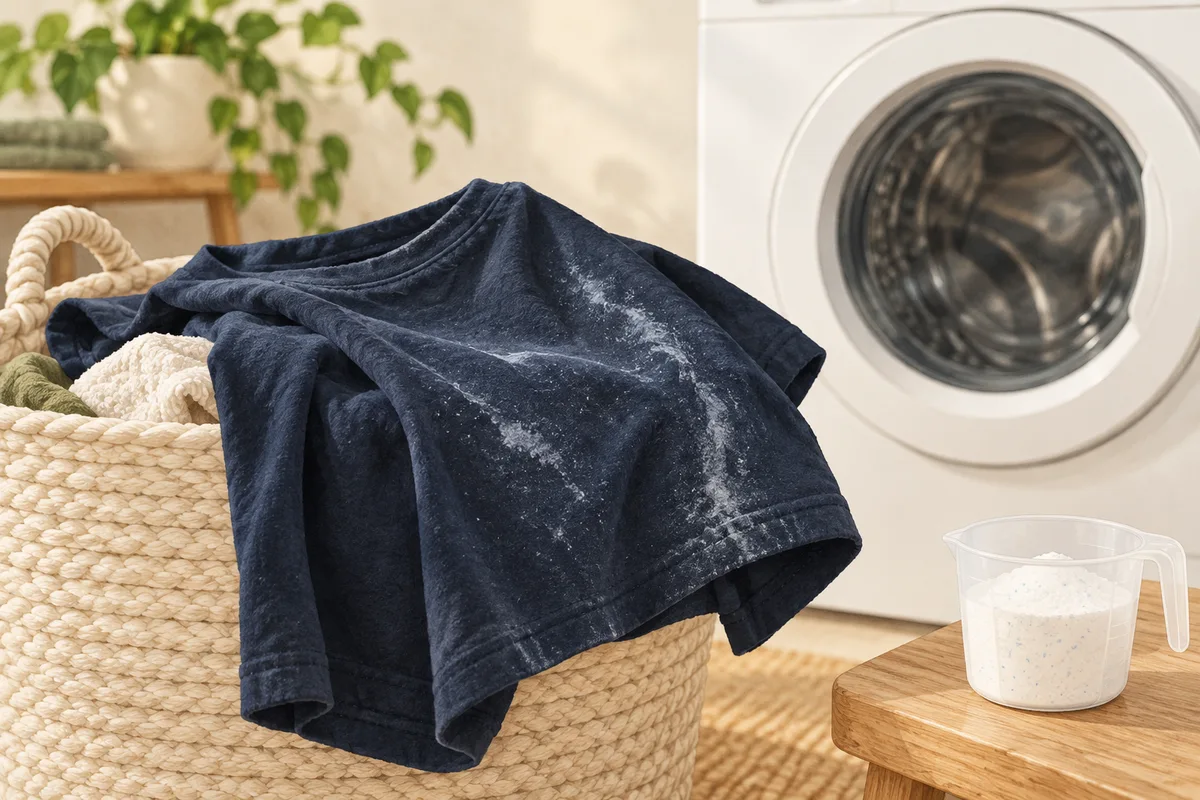
Look at the residue before changing the wash
A white mark on a dark shirt is not automatically leftover detergent. Loose fibers, undissolved powder and a film caught in fabric folds can look similar from a distance. Start with what you can see, then check what went into that load.
| What you notice | What to check | First adjustment |
|---|---|---|
| Loose fuzz or tiny fibers | Towels, tissues in pockets or other lint-shedding items in the load | Separate lint producers from garments that collect it; empty pockets. |
| Powdery specks or pale streaks | Detergent dose, product placement, cold-water suitability and a tightly packed load | Compare the actual dose and loading method with both labels. |
| Film concentrated in folds or on activewear | Body soil interacting with detergent, mixed fabrics and cycle choice | Check the washer's residue guidance before choosing a hotter wash. |
| Powder plus a stiff feel across several loads | Water hardness and the detergent formulation | Check local water information; do not identify minerals from the mark alone. |
The American Cleaning Institute's laundry troubleshooting guide distinguishes powder residue from lint and notes that some powder detergents can interact with hardness minerals. Several causes can occur together.
Check the dose, placement and room to move
Read the detergent label for the load size and concentration you actually use. A full measuring cap is not a universal dose. Check whether your washer requires HE detergent and which compartment or drum location the manual specifies. Do not put every product in the same dispenser.
Maytag's residue guidance warns against exceeding the dispenser's maximum line. That line is a limit, not a target for every load. If the drum was tightly packed, divide the next load within the manufacturer's capacity guidance instead of adding more product.
Record the detergent, measured amount, load contents and cycle. This gives you something concrete to compare if the next load has the same problem.
Why a hotter wash is not always the answer
Very cold water can leave some detergents poorly dissolved. But Whirlpool also describes a different residue involving body soil and detergent that warmer water can make worse. It recommends cooler settings for that situation when the fabric permits.
That is why “wash everything hot” is an unreliable shortcut. Match the garment's care label, the detergent instructions and your model's troubleshooting advice. A heavy-duty cycle mentioned for one washer is not permission to use it on a delicate garment.
What to do with the affected clothes
- Inspect before drying. Check the marks and the care label. The ACI laundry basics guide recommends checking for remaining stains before drying because heat can set some stains.
- Choose the matching correction. If your washer's residue instructions recommend an extra rinse, use that option within the garment's care limits. If the issue looks like lint, first correct the sorting problem. Do not automatically add another full dose of detergent.
- Recheck the result. Compare the same marked area. If it has not improved, stop repeating the same treatment and review the likely cause.
A mark that remains may need garment-specific advice. Avoid escalating to acid soaks, bleach or aggressive scrubbing just because a rinse did not help.
If the residue keeps returning
Change one plausible variable at a time on a normal, care-compatible load. Otherwise, switching detergent, temperature and cycle together makes the result difficult to interpret.
Check scheduled washer cleaning in the manual if buildup is suspected. For a separate odor problem, see what to check when a front-load washer smells like mildew. Cleaning the washer is not proof that every fabric mark came from its interior.
If correct dosing, loading and model-specific guidance do not resolve recurring residue, contact the manufacturer with the model number, photos and your wash notes. Poor draining or error codes also warrant model-specific support rather than repeated wash experiments.
For cleaning cloths, follow our separate guide to washing microfiber cloths; those care requirements should not be generalized to all clothing.
If the washer also bangs or moves during a cycle, treat that separately: see when to stop a shaking washing machine before running another load.