
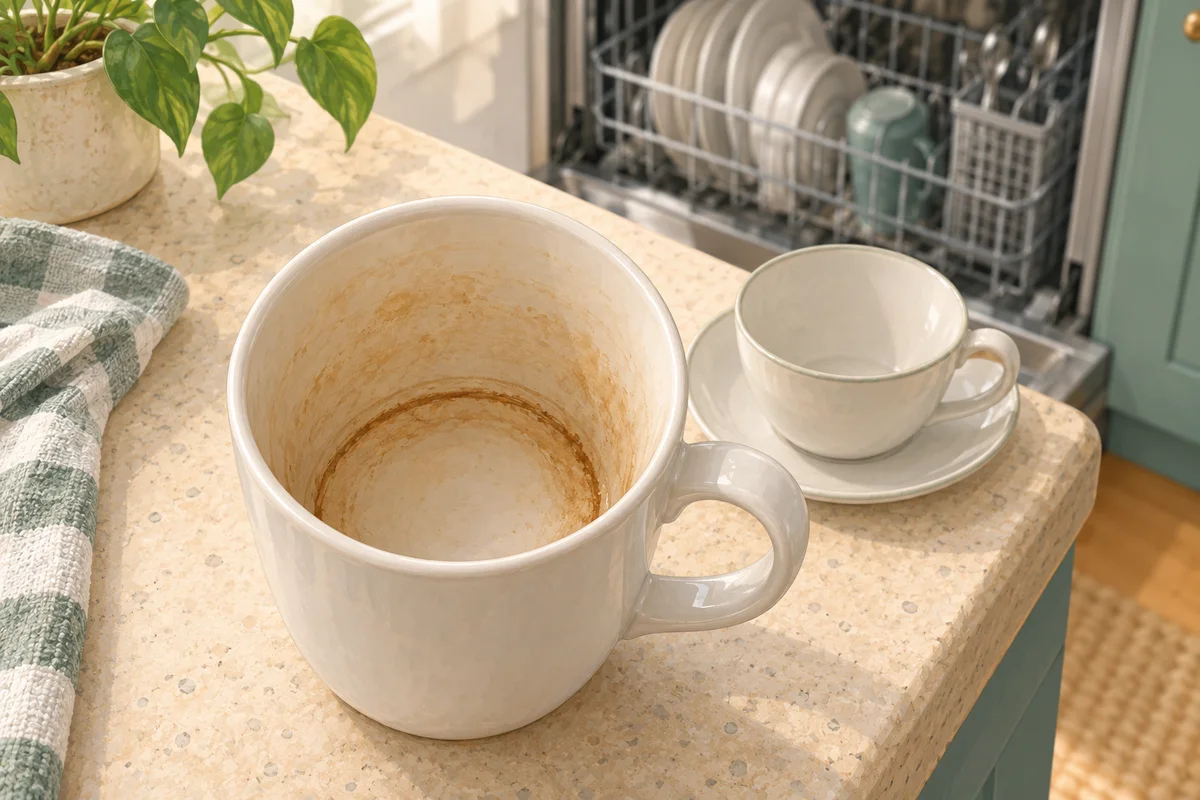
If your dishwasher is not removing tea stains from mugs, first check whether the brown marks are confined to tea-drinking surfaces or whether the rest of the load is dirty too. A remaining tea ring alone does not identify a broken dishwasher. Check the mug's care instructions, spray access, detergent and permitted wash cycle before considering repair.
The most useful first step is to describe the mark accurately. A brown ring, loose grains, cloudy film and damaged glaze call for different decisions. Use the comparison below before changing products or running another cycle.
Dishwasher not removing tea stains from mugs: start here
- Let the mug cool. Examine the inside in good light and compare it with other items from the same load.
- Separate color from debris. Note a fixed ring, loose particles, greasy food residue or a broader film.
- Check the mug's care instructions. Identify restrictions for decoration, glaze, insulation, temperature and cleaning products.
- Review the completed wash. Record the cycle and detergent actually used, rather than assuming the strongest setting was selected.
- Choose one appropriate correction. Address an obvious loading obstruction or use the mug maker's stain-care method. Do not combine several cleaners.
Compare the mark with the rest of the load
| Observation | First check | What it does not prove |
|---|---|---|
| Brown ring mainly inside tea mugs | Mug care and compatible stain treatment | A failed pump or heater |
| Loose grains inside several cups | Loading and permitted routine maintenance | That every brown speck is tea |
| Food remains across the load | Spray access, detergent release and cycle suitability | A specific faulty component |
| Yellow-brown film on many unrelated items | Water-quality history and manufacturer support | That stronger mug cleaner will solve it |
| Cracks, chips or an altered surface | The mug manufacturer's advice on continued use | That more scrubbing will restore the finish |
GE distinguishes tea or coffee marks in cups from broader yellow-brown discoloration, which can involve iron in the water. Color alone is not a water test; do not buy treatment equipment on that observation alone.
Why is my tea staining my mug?
Tea can leave a colored deposit on the drinking surface. Miele's dishwashing guide specifically describes stains forming when black tea is brewed with hard water and left standing. That is one relevant condition, not a diagnosis for every brown mug.
Compare usage before blaming the appliance. If one favorite tea mug is marked while water glasses and dinner plates are clean, record that pattern. If many unrelated pieces have the same discoloration, widen the investigation beyond the beverage.
- Is the mark inside the mug where tea sits?
- Does a rarely used mug have the same mark?
- Did discoloration begin after a change in water supply or detergent?
Check detergent, cycle and spray access
Bosch's tea-stain guidance recommends reviewing the wash program and checking obstructions, including blocked spray nozzles and items that interfere with detergent release. Its named programs and settings apply to its covered appliances; use your model's instructions for the equivalent choice.
Start with something you can verify. A pan handle in front of the dispenser is an observable loading problem. A suspected temperature fault is not confirmed by a brown ring. Do not change the household water heater or add extra detergent on that basis.
- Confirm the product is automatic dishwasher detergent and follow its label and the appliance's dosing guidance.
- Make sure the mug's opening faces the intended spray area and is not covered by another item.
- Check whether the selected cycle matches the soil level and is permitted for the mug.
- Inspect or clean spray components only where the manual gives a user procedure.
Separate rinse aid instructions from stain-treatment instructions. Bosch discusses rinse aid and additional functions, but that does not make rinse aid a guaranteed remover for an established tea ring. Avoid adding an unrelated cleaner to the dispenser.
Is tea staining permanent?
You cannot tell from color alone. A removable deposit and a changed or damaged finish can look similar at a glance. Use the mug maker's approved cleaning method and reassess the surface before escalating.
There is no universal soak time or dose that covers plain glazed ceramics, hand-painted mugs, metallic decoration and insulated drinkware. If the care guide permits a food-contact stain remover, follow its material, dilution, contact-time and rinsing instructions exactly. Never mix cleaning products.
- Stop if the surface becomes rough, dull or visibly damaged.
- Do not use an abrasive simply because the mug is white.
- If instructions are missing, ask the mug manufacturer instead of experimenting with stronger chemistry.
When the problem is broader than tea stains
For loose debris, follow the separate guide to grit left in top-rack glasses. If ordinary food odor is also present, the dishwasher odor checklist covers routine checks without treating smell as proof of a failed part.
Water that spills from the outside base while unloading has its own explanation: why inverted mug bases collect water. Do not group these symptoms together merely because they appeared after the same cycle.
Keep a short comparison note: mug identity, mark location, condition of other dishes, cycle, detergent and the one change made. If the rest of the load remains dirty after permitted checks, share that record and the model number with appliance support. Stop sooner for leaks, burning smells or service errors.
Method: manufacturer guidance synthesized with AI assistance. No stain-removal, detergent or appliance testing was performed. The illustration depicts a symptom, not a tested result.