
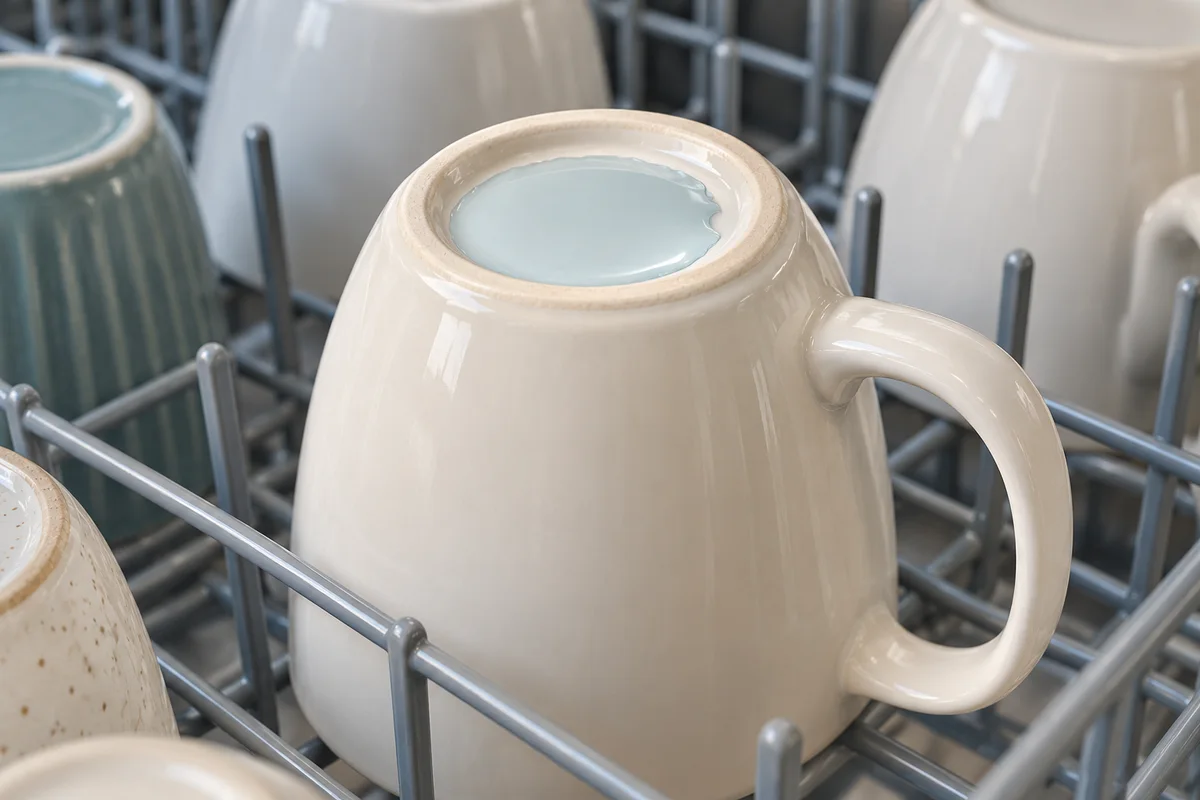
Water pooling on the bottom of mugs in the dishwasher often sits in the recessed outside base of an upside-down mug. That small hollow can hold water even when the machine drains normally. Use a stable angle allowed by the rack and mug instructions, then handle any remaining puddle carefully while unloading.
First confirm where the water is. A shallow puddle outside an inverted mug, a cup that flipped upright and standing water in the dishwasher tub are three separate situations. Only the first is the focus of this guide.
Why water pools on mug bottoms in the dishwasher
Turn a dry mug upside down on the counter and inspect its base. Many mugs have a raised foot ring around a recessed center. When that base faces upward in the dishwasher, it acts like a shallow dish.
GE recommends angling items, especially those with concave bottoms, for drainage. Frigidaire notes that concave surfaces can retain small amounts of water. Neither observation means a small puddle proves a drain fault.
- Base shape: look for a continuous raised ring around the water.
- Final position: check whether the mug stayed mouth-down.
- Other symptoms: note dirty water, debris, an error or water elsewhere.
Locate the water before choosing a fix
| Where the water is | What you observe | Useful next action |
|---|---|---|
| Shallow outside base | Mug remains inverted; foot ring surrounds the puddle | Review a stable angle and unloading order |
| Inside the drinking cavity | Cup or container has turned opening-up | Review permitted support or retention |
| Dishwasher tub | Water is in the appliance rather than only on a mug | Check the model's normal-water and drainage guidance |
| Water containing loose particles | Visible grains remain on or inside items | Assess wash quality separately from base shape |
For example, a clean inverted mug with a wet outside foot and clean plates below suggests a different next check from a lightweight cup standing upright and full of wash water. Keep those observations separate when describing the problem to support.
Angle the mug without destabilizing the rack
Use the rack's intended supports and loading positions. The aim is to give the shallow base a way to drain while keeping the mug secure and its drinking surface exposed to the wash.
- Confirm dishwasher compatibility. Check the mug's care information before changing its cycle or placement.
- Find its supported position. Compare the mug's size and shape with the loading diagram for your machine.
- Try a stable permitted tilt. Do not balance it precariously on a handle, neighboring glass or loose object.
- Check surrounding clearance. The mug should not collide with other pieces, the top of the tub or a spray arm.
- Observe the next normal load. Note whether it stayed in place and whether less water remained in the base.
There is no single angle in degrees that fits every mug and rack. A deep foot ring may still retain water at an otherwise sensible loading angle. If the only way to empty it is an unstable position, choose stability and manage the remaining water while unloading.
Do not lower one side of the upper rack as a universal trick. Some models require equal rack heights. The Bosch Ascenta manual, printed page 12, explicitly requires that for its described RackMatic arrangement. Follow your own model's adjustment instructions.
Will a drying setting or rinse aid eliminate the puddle?
They may improve general drying, but they do not change the mug's shape. Frigidaire describes rinse aid and drying options while also acknowledging water retention on concave items. Use the features your model actually provides, within the mug's care limits.
- Check whether the completed program included a drying phase.
- Review the rinse-aid instructions before changing its setting.
- Avoid choosing maximum heat solely to remove one trapped puddle.
- Allow the normal program to finish before judging its result.
A useful comparison is the same mug in a permitted new position during an otherwise ordinary load. Record the result as an observation, not a guarantee that the setting will work for every mug.
Unload without wetting the dishes below
After the program ends, follow the appliance's opening and cooling instructions. Keep clear of escaping steam. Do not handle a hot mug just to empty its base sooner.
- When safe to unload, inspect the upper rack for trapped water before pulling it abruptly.
- Unload the lower rack first where your manual allows, so water from above cannot spill over those dishes.
- Lift each wet mug carefully and tip the small puddle into the sink.
- Dry the outside base with a clean dish towel if necessary, then put the mug away when dry.
This is an unloading routine, not a repair. If dishes also have visible residue, address cleaning quality rather than simply wiping away the evidence.
When the water points to a different problem
A cup that has turned upright needs the approach in keeping lightweight containers from flipping. Water carrying particles deserves the separate top-rack grit checks.
If the new position produces a rhythmic knock, stop and review spray-arm interference and dishwasher noise. Do not continue with a load that obstructs a moving component.
For water in the tub: consult the exact model's normal-water and drainage guidance. A mug-base article cannot establish what water level is normal for that appliance. Persistent unexpected water, a leak or a service error belongs with manufacturer support.
Method: manufacturer guidance synthesized with AI assistance. No drying-time or loading-angle test was performed. The illustration shows the outside foot recess conceptually, not a model-specific loading instruction.