
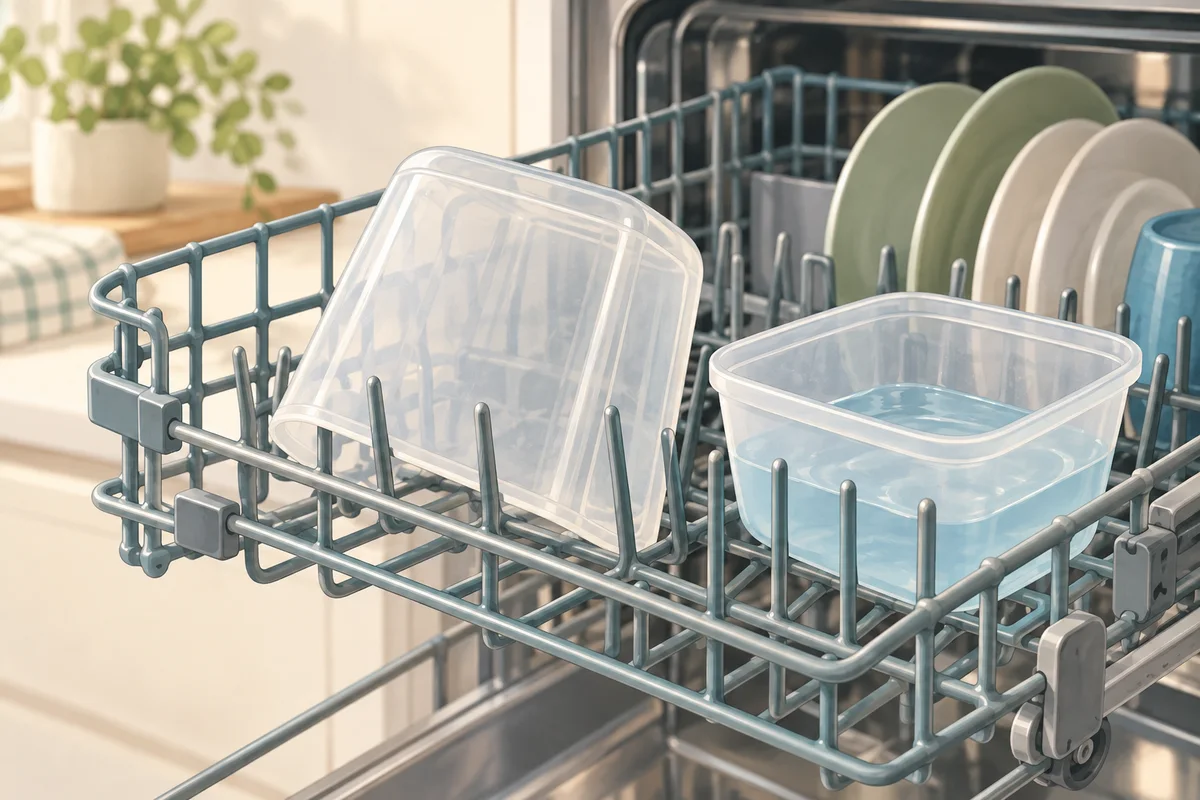
If you want to keep Tupperware from flipping over in the dishwasher, start with a dishwasher-safe container, a stable mouth-down position and the retaining features approved for your rack. Use a compatible small-item clip when the manual provides one. Keep the opening exposed to the spray and check that nothing obstructs a spray arm.
A container that comes out upright and full of water needs a different fix from one that stayed in place but is still wet. The checks below help you choose a restraint without sacrificing the wash.
How to keep Tupperware from flipping over in the dishwasher
- Identify the container. Check its dishwasher symbol or care instructions, including separate instructions for the lid.
- Find the correct rack position. Use the loading diagram for your dishwasher and the container maker's restrictions.
- Place it opening-down and supported. Leave room for water to reach the interior. Do not nest another container inside it.
- Use an approved retaining feature if needed. Match a clip or holder to the dishwasher model and the item's shape.
- Check the entire load. The rack should slide in normally, and the container must not hang into a spray arm's path.
Tupperware's current care guidance directs owners to the product insert or dishwasher symbol and recommends the top or middle rack. That is not permission to machine-wash every old, unmarked or differently branded container.
Choose a retaining method that fits your rack
The useful question is whether the holder keeps this particular piece stable while leaving its dirty surfaces accessible. A restraint that covers the opening can solve tipping while creating a cleaning problem.
| Method | Best starting point | Reject it when |
|---|---|---|
| Normal rack supports | The container sits securely in the approved loading position | It rocks, nests against another item or falls through |
| Model-compatible small-item clip | The manual identifies it for lightweight items | The attachment is loose or the clip blocks the opening |
| Built-in holder or covered small-item basket | The instructions explicitly cover that item and placement | You must force the piece in or obstruct water access |
| Hand washing | No permitted secure arrangement fits | Use the container's hand-care instructions, not a harsher substitute |
For a concrete example, the Bosch Ascenta manual, printed page 12, describes small-item clips intended to prevent lightweight pieces from tipping and filling with water. This establishes their purpose on the covered models. It does not establish that the same clip fits another rack.
What is the best way to put Tupperware in the dishwasher?
Use the item's permitted rack and a position that combines support, spray access and drainage. GE's loading guidance emphasizes spacing, suitable angles and unobstructed spray-arm movement.
- Load the lid separately so it cannot seal or shield the container.
- Look from the direction the water will approach: another bowl should not cover the opening.
- Check tall utensils below the container as well as nearby cups.
- After adjusting a rack feature, confirm it is locked as its manual requires.
For example, a wide shallow tub may rest differently from a narrow snack cup even when both carry a dishwasher-safe symbol. Judge each shape separately. Filling the surrounding space with more dishes is not a substitute for checking stability.
Is it bad to put plastic containers in the dishwasher?
Compatibility depends on the individual product. If its dishwasher instructions cannot be confirmed, use the maker's hand-washing guidance instead of guessing from the brand or recycling number.
Can I put glass Tupperware on the bottom rack?
Check the instructions for the glass base and lid separately. A placement allowed for a glass container does not transfer to a lightweight plastic tub. Weight alone does not tell you which rack, temperature or cycle the product permits.
Avoid restraints that create a second problem
A loose weight, ordinary elastic band or generic mesh cover has not been shown here to be compatible with your appliance. Do not treat an online demonstration as a substitute for an approved accessory.
- Do not wedge a knife or heavy plate over a tub.
- Do not stretch a restraint across moving rack or spray components.
- Do not force a clip onto a wire or container rim it does not fit.
- Do not keep using a visibly damaged accessory.
If a shifted item causes knocking, follow the appliance's pause instructions and let spraying stop and contents cool before inspecting. Our guide to dishwasher rattling and spray-arm interference explains when a loading check is appropriate and when to stop.
Check what changed after the next normal load
Note three results: whether the tub stayed mouth-down, whether its interior is clean, and where any water remains. A stable but dirty tub needs a wash-access check. A stable clean tub with droplets has a drying issue rather than a tipping issue.
When particles also remain in glasses, use the top-rack grit checklist. A little water on the outside foot of an inverted cup is different again: see water pooling on mug bottoms.
Before buying a clip: write down the dishwasher's full model number and compare the accessory's compatibility information. If the fit or attachment remains unclear, ask the manufacturer. A secure-looking improvisation is not evidence that a part is suitable.
Method: manufacturer guidance synthesized with AI assistance. No accessory comparison or dishwasher test was performed. The illustration is conceptual, not a model-specific loading diagram.